
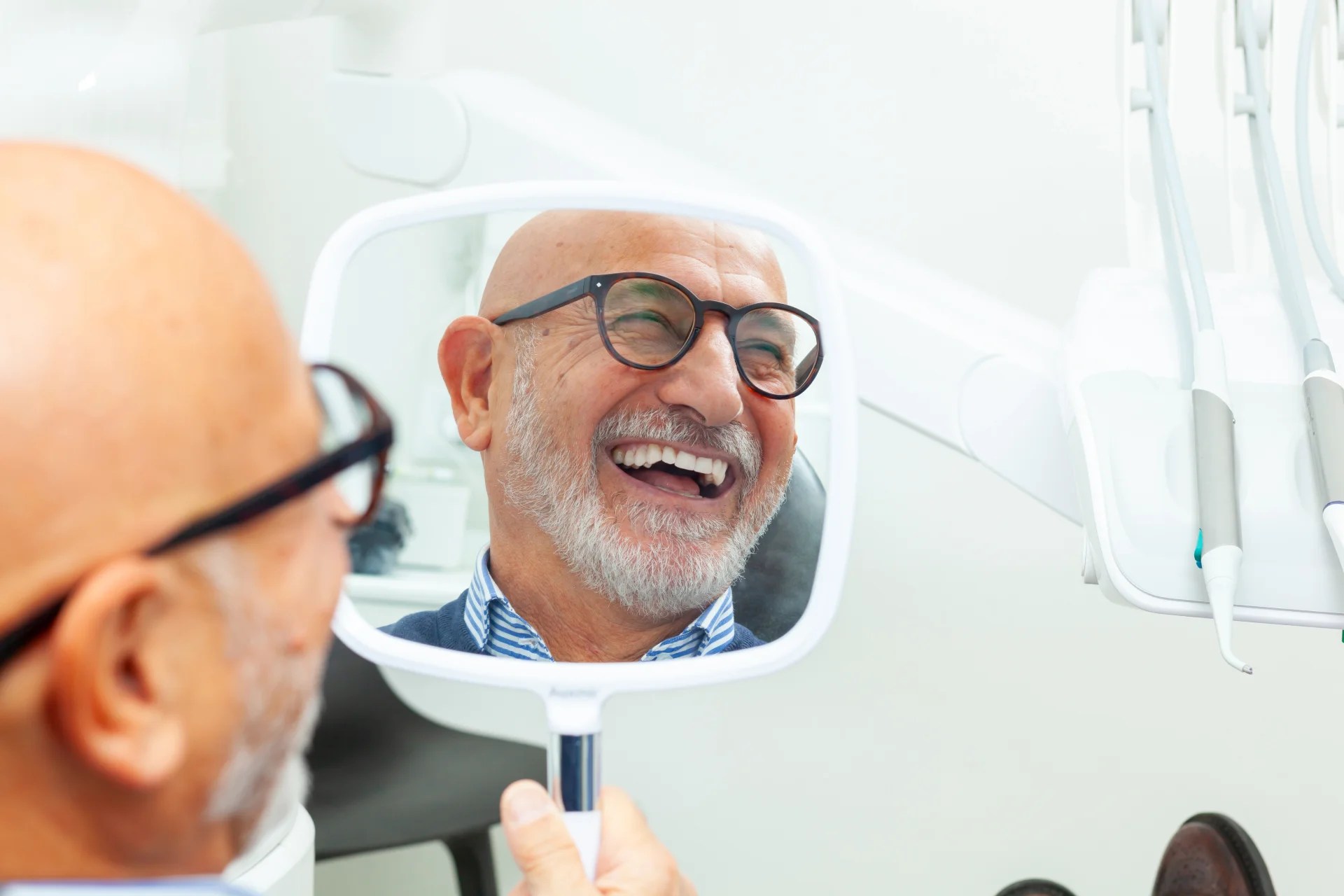
Full-arch dental implants are a way to replace a whole row of missing teeth with a fixed set of teeth, rather than a removable denture that you take out and put back in each day. For anyone facing the loss of most or all of their teeth in one jaw, they offer a stable alternative to traditional dentures.
If you are missing multiple teeth, or your remaining teeth are failing, it helps to understand how this option works before you decide anything. This guide explains what full-arch implants involve, who they suit, and what the process looks like, so you can weigh them up alongside your other dental implant options.
Quick Overview
- Full-arch dental implants replace an entire arch of teeth using a small number of titanium implants that support a single fixed prosthesis.
- Unlike removable dentures, the replacement teeth are fixed in place, so they do not slip or need to be taken out at night.
- Suitable patients usually have several missing or failing teeth and enough bone density, or can have bone grafting to build it up.
- The process runs over a healing period of a few months, from implant placement to the final teeth.
Below, we walk through what full-arch implants are, how they compare with dentures, and what to expect from the treatment.
What are full-arch dental implants?
Full-arch dental implants replace all the teeth in one jaw with a single row of fixed replacement teeth, anchored to the bone by a few strategically placed implants. Instead of one implant per tooth, an entire arch of prosthetic teeth is supported by around four to six titanium implants. Each set has three parts working together: the titanium implants in the bone, connectors on top, and the single arch of teeth that fixes onto them.
This is different from a single dental implant, which replaces just one tooth. With a full arch, the implants act as anchors for a connected, bridge-like fixed prosthesis that carries a whole set of teeth. You may also hear the treatment called full mouth dental implants when both arches are done together, though strictly a full arch restores one dental arch at a time, whether that is the upper or lower jaw.
Either way, the aim is the same: to replace missing teeth across a whole row with one connected set of fixed teeth, rather than filling gaps one at a time. The outcome is a fixed set of implant-supported teeth that stay put, which is why many patients prefer it when they are missing most of their natural teeth, and it is sometimes part of a wider full-mouth rehabilitation.
Full-arch implants vs traditional dentures
The clearest way to understand full-arch implants is to compare them with dentures. Traditional dentures are removable and rest on the gums, held in place by suction or adhesive. Full-arch implants are fixed to the jaw, so they behave far more like your own teeth.
Fixed teeth instead of a removable plate
Removable dentures rest on the gums and can move while you eat or speak, and because they sit on top of the gum rather than in the bone, they do not stop the jaw bone shrinking underneath. Full-arch implants, by contrast, are secured into the bone, so they stay stable and help maintain your facial structure. Unlike removable dentures, there are no plates to take out and no adhesive to manage. For some patients, an implant-supported denture that clips onto a few implants is a middle option, offering more grip than a standard denture while still being removable for cleaning.
How they compare with a dental bridge
Full-arch implants also differ from a dental bridge, which replaces a few teeth by anchoring to the neighbouring ones. A bridge suits smaller gaps, but it does not address the bone loss that tends to follow tooth loss, whereas implants placed in the jaw help keep the bone active. For replacing a whole arch, this difference in how each option affects the jaw bone is one of the main reasons patients look at implants.
How full-arch dental implants work
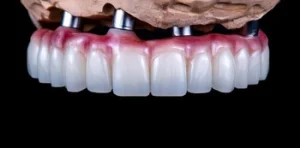 The idea behind full-arch implants is simple: a few well-placed implants can carry a full set of teeth. The titanium implants are placed into the jaw during dental implant surgery, where they fuse with the bone over time to form a solid, stable foundation.
An implant fuses to the bone through a natural process in which the jaw bone grows around the titanium, locking it firmly in place. Once healed, these implants can support a fixed prosthesis spanning the whole arch, made as one connected piece rather than separate crowns. Because the back implants are often angled to make the most of available bone, a full arch can frequently be supported by around four implants per jaw, sometimes avoiding the need for extensive grafting. Spreading the load across several implants is what allows a small number of them to carry a full arch securely.
As with most surgical procedures involving the jaw, this style of teeth replacement is planned in detail first, and the fixed teeth are then attached to the implants, restoring both the look and the function of a natural set of teeth.
Am I a suitable candidate for full-arch implants?
Full-arch implants tend to suit patients who are missing multiple teeth in an arch, or whose remaining teeth are failing and unlikely to be saved. A few things matter when working out suitability: your general health, the health of your gums, and how much bone is available to hold the implants.
Bone density is central, because the implants need enough bone to anchor into. Gum disease and tooth loss are common reasons the jaw loses bone in the first place, so any active gum disease is usually treated before implants are placed. Where there is not enough bone, bone grafting can build up the implant sites first. Certain health conditions and habits, such as heavy smoking or poorly controlled diabetes, can affect how well implants heal, so your dentist will talk these through honestly. After a detailed check, including scans of your bone structure, your dentist draws up a personalised treatment plan.
Most patients who are missing most of their teeth can be considered, but each case needs its own assessment, and making sure the treatment suits you beforehand matters more than rushing in. Age on its own is rarely the barrier patients expect; your bone and general health matter far more than how old you are, and many older adults are well suited to the treatment.
The full-arch implant procedure, step by step
Full-arch treatment is a surgical procedure carried out in stages over several months. Knowing the steps ahead of time makes the whole treatment process easier to follow, and the full-arch implant procedure is often less worrying than it first sounds.
Planning and placement
It starts with a detailed assessment, including scans, so your dentist can map out the implant sites and build your treatment plan. On the day of surgery, the implants are placed into the jaw, and some patients have any failing teeth removed at the same appointment, so the surgical stage is handled together. This is the most involved part of the process, and as an invasive procedure it is planned carefully around your bone structure.
Healing and final teeth
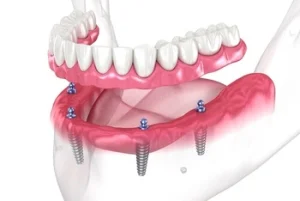 In many cases, a temporary prosthesis, a fixed set of temporary teeth, is fitted so you are not left without teeth while you heal. Over the following months, the implants fuse with the bone during the healing period, and follow-up appointments let your dental team check the implants are integrating as they should. Once your dentist confirms the implants are stable, the temporary set is replaced with your final teeth, a custom fixed prosthesis made to fit your mouth and match your natural facial appearance. Proper healing at each stage is what gives the finished result its strength.
Looking after your full-arch implants
Fixed teeth still need daily care. While implant-supported teeth cannot decay, the gum tissue and bone around the implants can become inflamed if plaque builds up, so ongoing maintenance is what protects them for the long term.
Daily cleaning
Good daily oral hygiene is the foundation: brushing and cleaning underneath and around the prosthesis as your dentist shows you. Because the prosthesis sits over the gum, cleaning beneath it matters as much as brushing the teeth themselves. Maintaining good oral hygiene keeps the gums around the implants healthy and supports your long-term oral health.
Regular check-ups
Keeping up regular check-ups and professional cleans lowers the risk of implant failure. If cleaning is neglected, the gum and bone around the implants can become inflamed or infected, a problem sometimes called peri-implantitis, which is far easier to prevent than to treat. Your dental team will explain exactly how to clean your particular prosthesis and how often to come in for a review.
Considering full-arch implants at Melton Smiles
If you are missing most of your teeth, or your teeth are failing and you want to understand whether full-arch implants could work for you, the useful first step is a proper assessment. At Melton Smiles, we examine your teeth, gums and jaw, explain whether full-arch implants are a suitable option for you, and set out the stages and costs clearly before anything begins.
To talk through your options, please call us on (03) 8007 2883.
Frequently Asked Questions
How much do full-arch dental implants cost in Australia?
Full-arch implants are a significant investment, and the cost varies widely depending on how many implants are used, the materials, and whether any preparatory work like grafting is needed. Because every case differs, the only accurate figure comes from an assessment and a written quote. Our practice offers payment plans to help spread the cost.
How long do full-arch dental implants last?
With good care, the implants themselves can last many years, often decades, because they fuse with the bone. The fixed teeth attached to them may need maintenance or replacement over time through normal wear. How long everything lasts depends heavily on your oral hygiene, general health, and keeping up regular check-ups.
Is getting full-arch dental implants uncomfortable?
The surgery is done under local anaesthesia, so you should not feel discomfort while the implants are placed, and sedation is available if you feel nervous. Afterwards, some swelling and soreness for several days is normal and is usually managed with simple pain relief. Most patients find the recovery more manageable than they expected.
Can I eat normally with full-arch dental implants?
Once healed, full-arch implants let most patients eat a much wider range of foods than dentures allow, because the teeth are fixed and stable. During the initial healing period, you will need to stick to softer foods while the implants settle. Your dentist will guide you on when you can return to a normal diet.
How soon can I get back to work after full-arch implant surgery?
Many patients take a day or two off work and ease back into normal activities soon after, depending on how many implants were placed and the kind of work you do. It is sensible to plan a quiet few days rather than a demanding schedule straight away, and heavier, physically demanding jobs may need a little longer. Your dentist will give you personalised guidance for your situation.
Note: Any surgical or invasive procedure carries risks. Before proceeding, you should seek a second opinion from an appropriately qualified health practitioner.
References
https://www.teeth.org.au/dental-implants
https://www.betterhealth.vic.gov.au/health/conditionsandtreatments/dental-treatment